
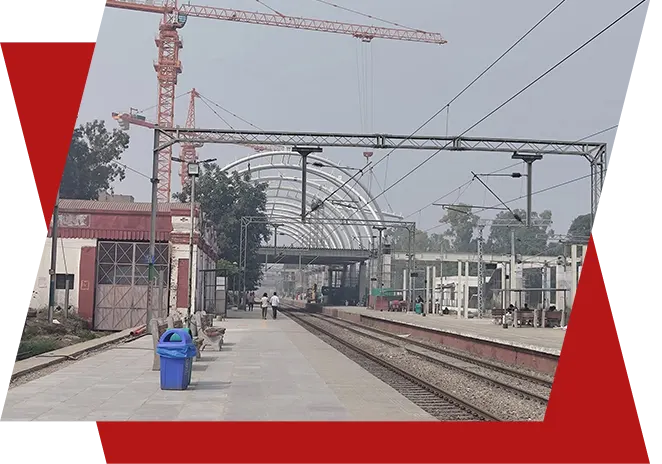
Railway bridges are critical parts of transport infrastructure. They carry heavy trains across rivers, roads, and valleys. These bridges must be strong, stable, and safe for long term use.
One of the most important parts of a railway bridge is the girder.
Girders are large steel beams that support the weight of the train and transfer the load to the bridge structure. These girders are not ready made. They are built through a detailed process called fabrication.
Steel bridge girder fabrication ensures that these components are strong, accurate, and able to handle heavy loads.
In this blog, you will understand how steel girders are fabricated for railway bridges and why this process is important.
What Is a Steel Bridge Girder
A steel bridge girder is a large structural beam used in bridges to support loads.
In railway bridges, girders carry the weight of trains and distribute it across the structure.
Simple explanation
A girder is the main beam that holds the bridge and supports the train load.
Why Steel Is Used for Railway Girders
Steel is widely used in railway bridge construction.
Key reasons
- High strength
- Ability to carry heavy loads
- Long lifespan
- Suitable for long spans
Railway bridges require materials that can handle constant movement and vibration. Steel provides these properties.
Types of Steel Bridge Girders Used in Railways
Different types of girders are used depending on the design of the bridge.
Plate Girders
What they are
Plate girders are made by joining steel plates to form a large beam.
Where they are used
- Medium span bridges
- Railway crossings
Benefit
They provide high strength and flexibility in design.
Box Girders
What they are
Box girders have a hollow box shape.
Where they are used
- Long span bridges
- High load applications
Benefit
They offer high torsional strength and stability.
Truss Girders
What they are
Truss girders are made using triangular steel structures.
Where they are used
- Long span railway bridges
Benefit
They distribute load efficiently.
Steel Bridge Girder Fabrication Process
Fabrication of railway girders follows a detailed process.
Step One Design and Engineering
Engineers design the girder based on load and span.
Includes
- Load calculations
- Structural drawings
- Material specifications
Design ensures the girder can handle train loads safely.
Step Two Material Selection
High quality steel is selected.
Common materials
- Structural steel
- High strength steel
Material must meet engineering standards.
Step Three Cutting and Shaping
Steel plates are cut into required sizes.
Methods
- Plasma cutting
- Flame cutting
Parts are shaped as per design.
Step Four Assembly of Components
Different parts of the girder are assembled.
Includes
- Web plates
- Flanges
- Stiffeners
These parts form the girder structure.
Step Five Welding
Welding joins all components.
Importance
- Creates strong joints
- Ensures structural integrity
Welding must be done carefully to avoid defects.
Step Six Drilling and Machining
Holes are drilled for bolts and connections.
Purpose
- Ensure proper assembly at site
- Maintain alignment
Step Seven Surface Treatment
Steel is protected from corrosion.
Methods
- Sand blasting
- Painting
- Coating
This improves durability.
Step Eight Inspection and Testing
Final inspection ensures quality.
Checks include
- Dimensional accuracy
- Weld quality
- Structural strength
Testing ensures safety before installation.
Challenges in Girder Fabrication
Fabricating railway girders involves several challenges.
Common challenges
- Handling large steel sections
- Maintaining precision
- Ensuring weld quality
- Meeting strict railway standards
Proper planning and expertise are required.
Importance of Precision in Railway Bridges
Railway bridges must be highly accurate.
Why precision matters
- Ensures smooth train movement
- Prevents structural stress
- Improves safety
Even small errors can affect performance.
Role of Quality Control
Quality control is critical in girder fabrication.
Key checks
- Material testing
- Weld inspection
- Dimensional verification
Strict quality control ensures reliability.
Safety Considerations
Railway bridges must meet strict safety requirements.
Safety measures
- Use of certified materials
- Proper welding procedures
- Regular inspection
Safety ensures long term performance.
Comparison of Girder Types
Girder Type | Best Use | Advantage |
Plate Girder | Medium spans | Flexible design |
Box Girder | Long spans | High stability |
Truss Girder | Large bridges | Efficient load distribution |
Applications in Railway Infrastructure
Steel girders are used in
- Railway bridges
- Overpasses
- Metro rail structures
They support safe and efficient transportation.
Future of Steel Girder Fabrication
Technology is improving fabrication processes.
Trends
- Automated welding
- Advanced cutting machines
- Digital design tools
These advancements improve accuracy and efficiency.
Conclusion
Steel bridge girder fabrication is a key part of railway infrastructure development.
It ensures that bridges are strong, safe, and capable of carrying heavy train loads.
From design and material selection to welding and inspection, every step plays an important role.
With proper fabrication, railway bridges can perform reliably for many years.
